

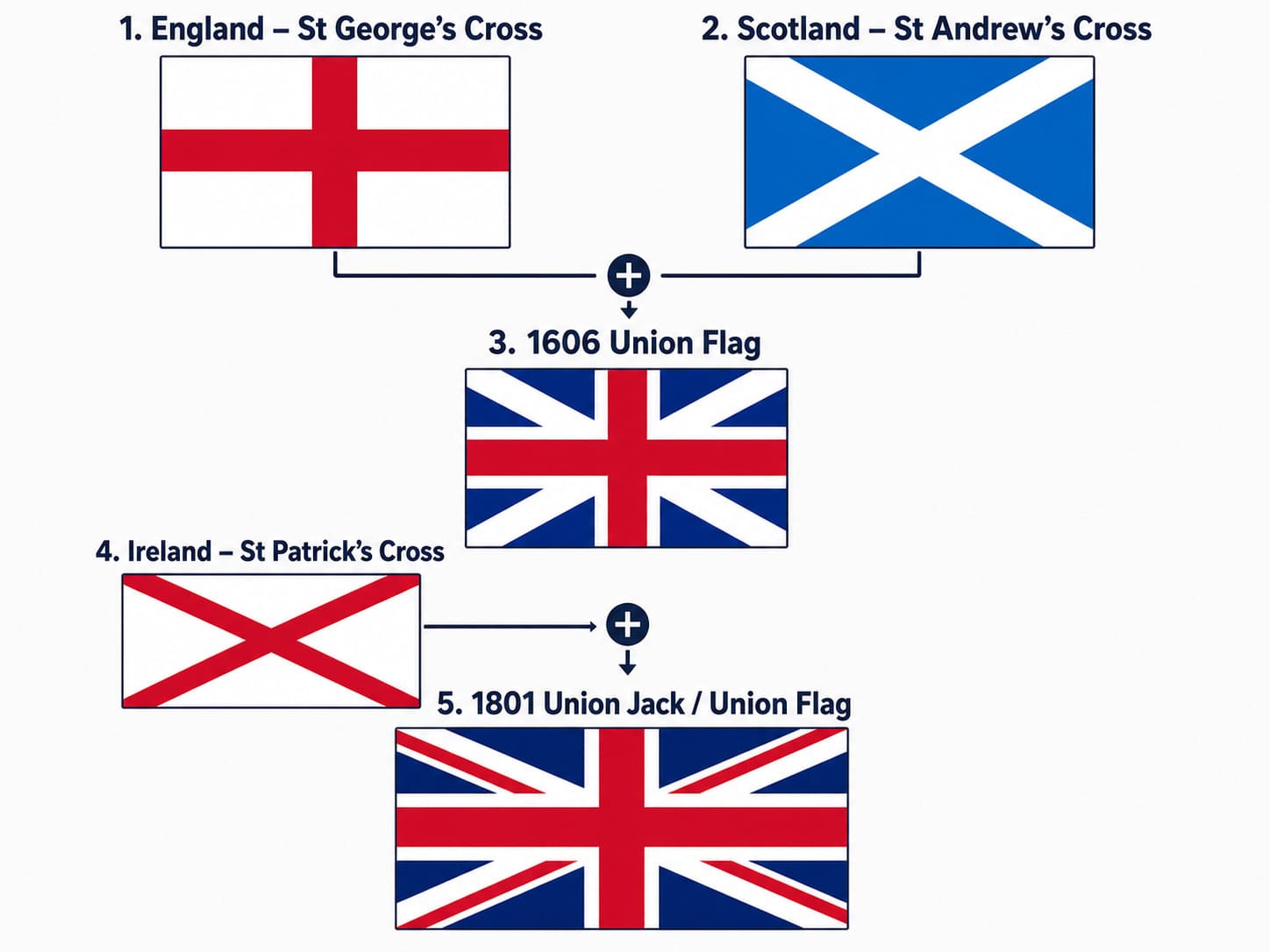
The UK flag did not appear in a single moment. Its first form was created in 1606 after England and Scotland came under one monarch. The design was retained when Great Britain became one kingdom in 1707, then changed in 1801 when a red saltire associated with St Patrick was added for Ireland. That 1801 design is the Union Flag, or Union Jack, flown today.
In other words, every cross records a stage in the formation of the United Kingdom. The UK government's Union Flag guidance confirms the two key design dates: the first Union Flag was created in 1606, while the present flag dates from 1801.
UK Flag History at a Glance
|
Date |
What happened |
What changed on the flag |
|
Before 1603 |
England and Scotland were separate kingdoms with separate national symbols. |
There was no shared UK flag. |
|
1603 |
James VI of Scotland also became James I of England, creating a union of the Crowns. |
No new flag was introduced immediately. |
|
1606 |
A royal proclamation joined the crosses of St George and St Andrew for use at sea. |
The first Union Flag appeared. |
|
1707 |
The Acts of Union created the Kingdom of Great Britain. |
Queen Anne kept the existing Union Flag design. |
|
1801 |
Great Britain and Ireland formed the United Kingdom of Great Britain and Ireland. |
The red saltire associated with St Patrick was added, creating the modern design. |
|
Early 1920s |
Most of Ireland left the United Kingdom. |
The flag remained unchanged. |
|
Today |
The design serves as the national flag of the United Kingdom. |
Both "Union Flag" and "Union Jack" are valid names. |
Before the Union Jack: Two Kingdoms and Two Crosses
The earliest Union Flag brought together two established symbols. England used the red cross of St George on a white field. Scotland used the white saltire of St Andrew on a blue field. A saltire is an X-shaped diagonal cross. The kingdoms remained politically separate at the start of the story.
1603 and 1606: One Monarch, Then the First Union Flag
1603: The Union of the Crowns
Queen Elizabeth I of England died in 1603 without children. James VI of Scotland inherited the English throne and also became James I of England.
The same monarch now ruled both kingdoms, but they did not become one country. England and Scotland kept separate parliaments and laws. This is why 1603 is called the Union of the Crowns rather than a political union.
1606: A Shared Flag for the Sea
English and Scottish ships soon disputed which flags should take precedence. In 1606, James issued a proclamation for a combined flag to be carried at sea. The design placed the red cross of St George over the white saltire of St Andrew on a blue field.
This was the original Union Flag. It represented the monarch's two realms, but it was not yet the flag of a united British state. Its first role was practical and maritime.

1707: The Flag of the New Kingdom of Great Britain
The next major change was constitutional rather than visual. The Acts of Union took effect in 1707, joining England and Scotland as the Kingdom of Great Britain and replacing their separate parliaments with the Parliament of Great Britain.
The Treaty of Union allowed Queen Anne to settle the flag of the new realm. She chose to retain the existing design, so the red cross of St George and white saltire of St Andrew continued together.
The flag had existed for more than a century before the kingdoms became one state. From 1707, it had a clearer national role as the flag of Great Britain.
1801: The Modern Union Jack Takes Shape
Ireland remained a separate kingdom under the British Crown until the Acts of Union created the United Kingdom of Great Britain and Ireland. The union took effect on 1 January 1801.
The College of Arms designed a revised flag for the new state. A red diagonal saltire associated with St Patrick was added to the existing design of St George and St Andrew. This created the red, white and blue Union Flag recognised today.
The red saltire was counterchanged with the white Scottish saltire. Their positions alternate around the flag so neither appears to be merely a border around the other. This is why the diagonal stripes look offset. The apparent unevenness is intentional.
What Do the Symbols on the UK Flag Mean?

The modern Union Jack combines three heraldic crosses:
• St George for England: a red upright cross, separated from the blue field by a white border.
• St Andrew for Scotland: a broad white diagonal saltire on the blue field.
• St Patrick for Ireland: a narrower red diagonal saltire, also edged in white.
The Royal Family's explanation of the Union Jack identifies these three crosses and confirms that the current design has been flown since 1801.
Together, the crosses show how the flag developed through unions between kingdoms. They are not a simple list of the UK's four constituent nations, which is why one country is absent.
Why Is Wales Not on the Union Jack?

Wales has no separate symbol in the Union Flag because of its constitutional position when the first design was created. By 1606, Wales had already been united with England and was not treated as a separate kingdom for the purpose of the new flag. It was therefore included under the cross of St George.
This does not mean Wales lacks its own national identity or flag. The red dragon remains the national flag of Wales. It explains why the 1606 designers combined England and Scotland without adding a separate Welsh emblem. The Union Jack reflects the political structure of that time, not a modern list of nations.
Why Is the UK Flag Called the Union Jack?
Union Jack” and “Union Flag” are both correct names for the UK’s national flag. The design was initially described as the “British flag” or “flag of Britain”, while the term “Union” first appeared in 1625.
The name “Jack” developed from naval use. At the time, a jack could mean a small flag flown from a staff on a ship’s bowsprit. By 1627, a small version of the Union Flag was being called the “Jack”, “Jack flag” or “King’s Jack”, and in 1674 the Admiralty recognised “Union Jack” as an informal name.
It is a myth that “Union Jack” is correct only when the flag is flown at sea. The Admiralty used “Union Jack” and “Union Flag” interchangeably from the 17th century, regardless of use. An Admiralty Circular confirmed either name was valid in 1902, and Parliament approved that position in 1908. (Source: Flag Institute: Union Jack or Union Flag?)
Can the Union Jack Be Flown Upside Down?
The Union Jack has a correct way up because its diagonal stripes are offset. On the side nearest the flagpole, the broader white diagonal should appear above the red diagonal in the upper corner.
The difference can be easy to miss when the flag is moving, but it is part of the design. The Flag Institute's Union Flag specification shows the order of the diagonals.
For anyone displaying the flag, the simplest check is to look at the top corner next to the flagpole before raising it.
Why Did the Flag Stay the Same After Irish Independence?
Most of Ireland left the United Kingdom in the early 1920s, while Northern Ireland remained. This changed the state's territory and later its official name, but the 1801 Union Flag was not redesigned.
The red saltire of St Patrick therefore remains part of the flag as a record of the union with Ireland. Today, it sits within the national flag of the United Kingdom of Great Britain and Northern Ireland.
This is another reason the design should be read as accumulated history. Its elements record the constitutional changes that created it, even when later political changes did not produce a new flag.
From Royal and Naval Flag to National Symbol
The Union Flag was originally a royal flag. When the present design was made official in 1801, it was ordered to be flown on the King’s forts and castles. The Royal Family: Union Jack
Today, the Union Flag is the national flag of the United Kingdom of Great Britain and Northern Ireland, as well as the Crown Dependencies and Overseas Territories. It is described as a symbol of national unity and pride, and UK government buildings are encouraged to fly it throughout the year. Other UK national, county and local flags may also be flown on appropriate occasions. GOV.UK: Union Flag flying guidance
A Flag with More Than 400 Years of History
The Union Jack is not a collage created all at once. It is a visual timeline. The 1606 design joined England and Scotland under one monarch. The 1707 union turned Great Britain into a single kingdom. The 1801 addition of the red saltire produced the flag the United Kingdom still flies.
Even the offset diagonals, the absence of Wales and the maritime nickname point back to particular moments in that story. Once you know what to look for, the familiar red, white and blue pattern becomes a compact record of British constitutional history.
If you would like to display the modern design, The Flag Men offers a fully sewn 6ft x 3ft United Kingdom flag of high quality.


