

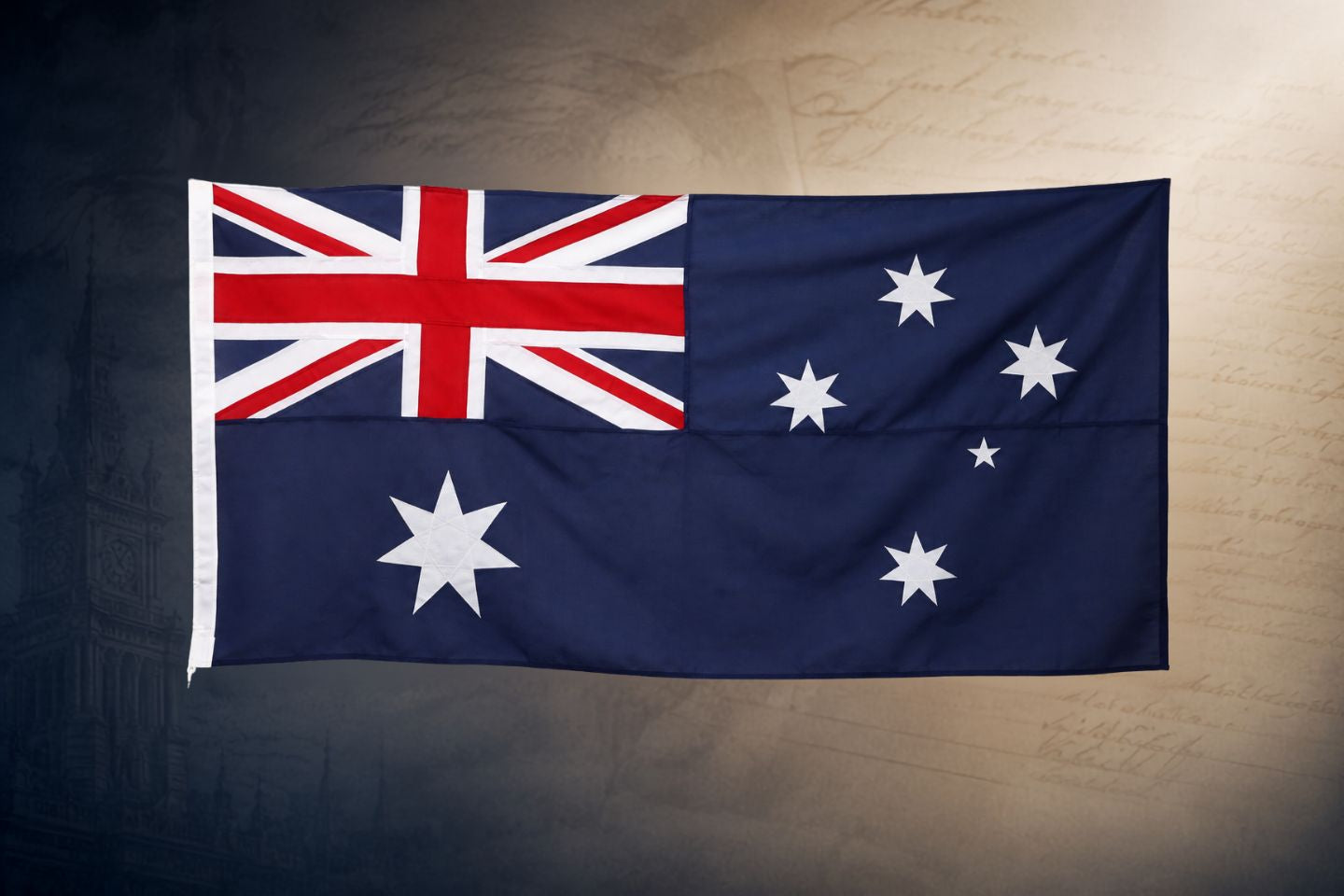
The Flags Act 1953 is the federal law that declares the blue Australian flag to be the Australian National Flag. It also names the Australian Red Ensign, describes both designs, allows other official flags to be proclaimed and preserves the right to fly the Union Jack.
Although Parliament passed the bill in December 1953, Queen Elizabeth II gave her assent on 14 February 1954. The Act came into force on 14 April 1954. A later amendment in 1998 added a national voting process that must be followed before the Australian National Flag can be replaced.
The correct name is the Flags Act 1953, although people sometimes search for it as the "1953 Flag Act of Australia". The Federal Register of Legislation lists the Act as current Commonwealth legislation and provides its full text.
Flags Act 1953 at a glance
| Question | Answer |
|---|---|
| What did the Act do? | It declared the blue flag described in the Schedule to be the Australian National Flag. |
| What else did it recognise? | It named the red version as the Australian Red Ensign and allowed the Governor-General to proclaim other flags and ensigns of Australia. |
| When did Parliament pass the bill? | 3 December 1953. |
| When did it receive assent? | 14 February 1954. |
| When did it commence? | 14 April 1954. |
| Is it still in force? | Yes. The Federal Register lists the Act as in force. |
| Can the national flag be changed? | Yes, but the process added in 1998 requires the existing flag and any proposed replacement to be put to qualified electors across Australia. A new design must receive a majority of all votes cast. |
Why Australia Needed a National Flag Law
Australia had used blue and red versions of its flag for more than 50 years before the Flags Act became law. The winning design from the 1901 federal flag competition became known as the Commonwealth Blue Ensign. An almost identical red flag became the Commonwealth Red Ensign.
Their different uses caused confusion. The blue ensign was initially associated with government and official use. The red ensign was used by merchant ships and was also widely flown by private citizens on land. The Union Jack, also known as the Union Flag, remained prominent as well.
The position changed gradually. Prime Minister Robert Menzies encouraged public use of the blue ensign in 1941. Prime Minister Ben Chifley supported the same approach in 1947. In 1951, King George VI approved the Australian Government's recommendation that the Commonwealth Blue Ensign should become the Australian National Flag. These steps are recorded in the government's account of how the Australian National Flag was chosen.
The Act settled the central question in legislation. Section 3 declared the blue flag to be the national flag, while section 4 named the red flag as the Australian Red Ensign.
For the story from Federation and the 1901 competition onwards, read our history of the Australian National Flag.
How the 1953 Bill Became Law in 1954
The dates attached to the Act can appear contradictory. It is called the Flags Act 1953, but the Federal Register also identifies it as Act No. 1 of 1954. Both descriptions are correct.
| Date | Parliamentary or legal event |
| 3 December 1953 | The Flags Bill passed the Australian Parliament. |
| 12 December 1953 | Governor-General Sir William Slim reserved the bill for the Queen's pleasure rather than granting assent himself. |
| 14 February 1954 | Queen Elizabeth II gave her assent during her Australian visit, after opening the third session of the 20th Parliament. |
| 15 February 1954 | The Queen's assent was made known to both Houses of Parliament. |
| 14 April 1954 | The assent was proclaimed in the Commonwealth Gazette and the Act commenced. |
The statute retained the 1953 short title because that was the title passed by Parliament. It became Act No. 1 of 1954 because royal assent was given in 1954. The government's Australian flags timeline confirms the parliamentary and commencement dates.

What Each Section of the Flags Act Says
The Act is a short statute with eight sections and two schedules. Each part has a distinct purpose.
| Section | What it covers |
| Section 1 | Gives the law its short title: Flags Act 1953. |
| Section 2 | Extends the Act to Australia's territories. |
| Section 3 | Declares the blue flag in Schedule 1 to be the Australian National Flag and sets the current process for replacing it. |
| Section 4 | Provides that the red flag in Schedule 1 is known as the Australian Red Ensign. |
| Section 5 | Allows the Governor-General to appoint other flags and ensigns of Australia by proclamation. |
| Section 6 | Allows the Governor-General to authorise a person, body or authority to use a flag or ensign by warrant, with or without an approved defacement. |
| Section 7 | Allows the Governor-General to publish rules for guidance on the flying or use of flags and ensigns covered by the Act. |
| Section 8 | States that the Act does not affect a person's right or privilege to fly the Union Jack. |
Schedule 1 describes the design of the Australian National Flag and the Australian Red Ensign. It sets out the position and relative size of the Union Jack, the seven-point Commonwealth Star and the five stars of the Southern Cross. Schedule 2 shows reproductions of the blue and red flags.
This legal description matters because it fixes more than a general arrangement of colours and stars. It records the number of points on each star and measures their positions and diameters as fractions of the flag's width.

The Measurement Error Corrected in 1954
The original Act contained a drafting error in the measurement of the Commonwealth Star. It stated that the star's outer diameter should be three-eighths of the flag's width. The intended measurement was three-tenths.
Parliament corrected the figure through the Flags Act 1954. The amendment applied from 14 April 1954, the same day the original Act commenced. The correction therefore aligned the statute with the established flag design rather than creating a visibly different national flag. The current Schedule records the Commonwealth Star's outer diameter as three-tenths of the flag's width.
This small correction is an important distinction. The Flags Act did not redesign the flag in 1954. It corrected the written measurement used to describe the existing design. The change is recorded in the Act's amendment history and was later explained in Australian parliamentary debate.
What the 1998 Amendment Changed
The Flags Amendment Act 1998 added subsections 3(2) to 3(4). These provisions set conditions for replacing the Australian National Flag.
Under the current law:
-
the existing Australian National Flag must be included with any proposed new flag or flags;
-
the choices must be submitted in every represented state and territory to electors qualified to vote for members of the House of Representatives;
-
a new flag must be chosen by a majority of all electors voting; and
-
Parliament must prescribe the form of the proposal, the voting method and the arrangements for adopting a successful new flag.
The amendment did not declare that the flag could never change. It created a public decision process and ensured that the present design would appear among the choices. The amendment received assent and commenced on 24 March 1998.
The Australian Red Ensign and other Official Flags
The Act does more than declare the blue national flag. Section 4 gives the red version its legal name, the Australian Red Ensign. Its design uses the same Union Jack, Commonwealth Star and Southern Cross, but on a red field rather than a blue one.
The Red Ensign has a separate maritime role. The Shipping Registration Act 1981 later confirmed it as the proper flag for Australian-registered merchant ships, as recorded in the government's Australian flags timeline. This is why the Red Ensign may be described as Australia's merchant flag, even though the Flags Act itself simply names and describes it.
Section 5 gives the Governor-General power to proclaim other official flags. The Australian Aboriginal Flag and Torres Strait Islander Flag were proclaimed as flags of Australia under this section in 1995. They were proclaimed again in 2008 to correct an administrative oversight. The Australian Defence Force Ensign was proclaimed under the Act in 2000.
Section 8 also makes one point explicit: the Act does not remove a person's right or privilege to fly the Union Jack.
What the Act Does "Not" Do
The Flags Act defines and recognises flags, but it is not a complete manual for everyday flag use. It does not set out every practical rule for displaying a flag at a school, home, business or ceremony. Section 7 allows rules to be published for guidance, while detailed Australian flag protocols are provided separately by the Australian Government.
The Flags Act 1953 itself does not create a general offence for burning, desecrating or damaging the Australian National Flag. However, the conduct may still be illegal under other Commonwealth, state, territory or local laws. For example, penalties may apply if someone damages a flag belonging to another person, lights a fire unlawfully, creates a public-safety risk or commits a public-order offence. In those situations, the offence arises from the surrounding conduct rather than disrespect towards the flag itself.
For practical display guidance, see our guide to Australian National Flag protocols and etiquette.
Why the Flags Act 1953 still Matters
The Flags Act gave the Australian National Flag a clear legal identity after decades of mixed use of the blue ensign, red ensign and Union Jack. It also recorded the flag's design in measurable detail and created a legal basis for recognising other flags of Australia.
Its later amendments show that the law is not frozen in its original form. Parliament corrected a technical error in 1954, revised provisions over time and added the national voting requirement in 1998. Yet its central declaration remains unchanged: the blue flag described in Schedule 1 is the Australian National Flag.
If you want to display that design at your home, school, workplace or ceremony, view our fully sewn Australian National Flag, made with individually appliqued stars, a fully sewn Union Jack, double-stitched hems and reinforced corners.


