

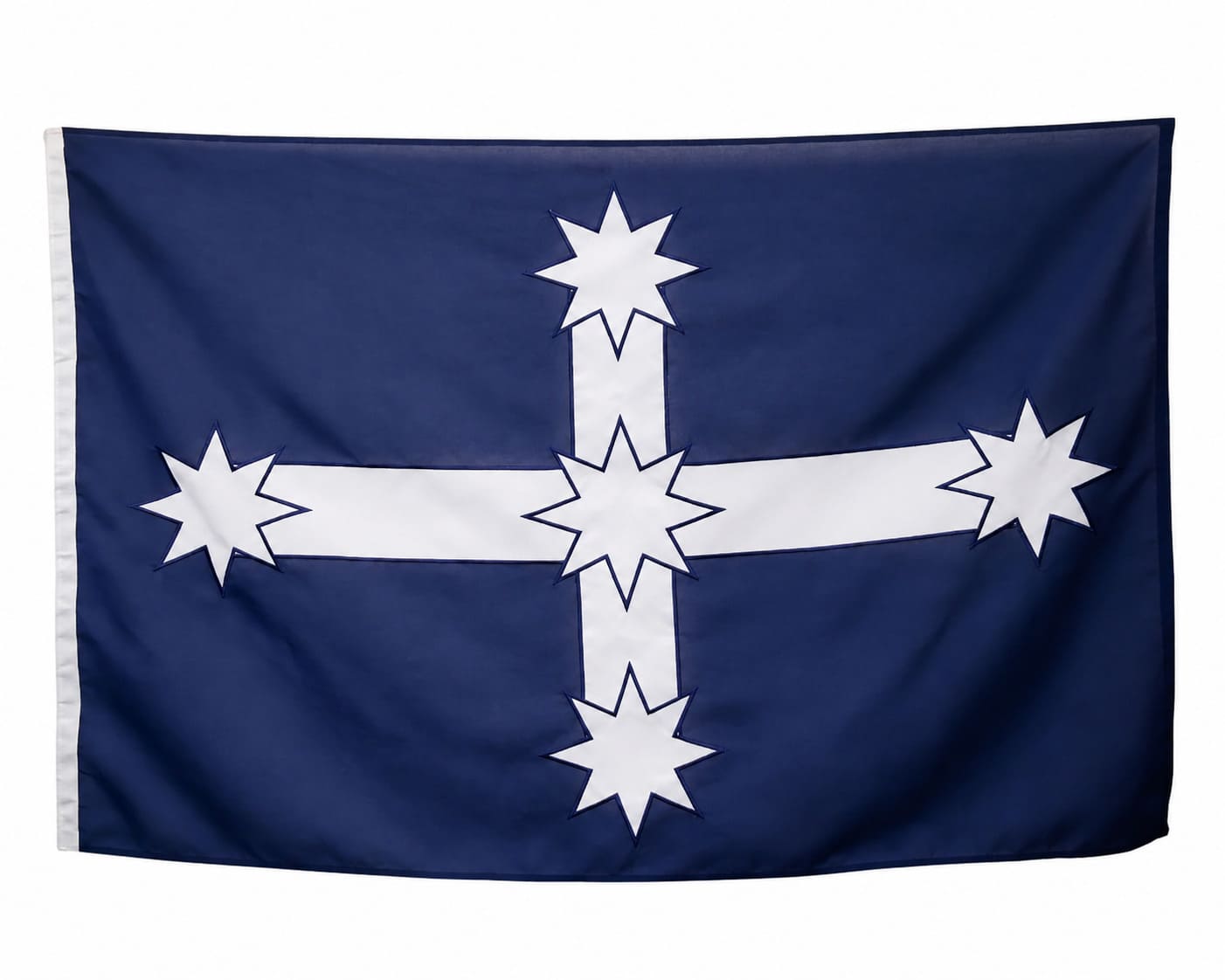
The Eureka Flag is a famous blue banner with five white stars. It has a large white cross in the center. This flag was the main symbol of the Eureka Rebellion in Ballarat, Victoria. Gold miners first raised it on 29 November 1854 at a large meeting at Bakery Hill.
This event happened during the Victorian Gold Rush. The Gold Rush was a time when thousands of people moved to Australia to find gold and get rich. These miners wanted to be treated fairly by the government. Today, many people see this flag as the start of Democracy in Australia. It represents the "Fair Go." In Australia, a "Fair Go" is the belief that everyone should have an equal chance to succeed.
The original Eureka Stockade flag is a key part of Australian History. It is now a protected object on the Victorian Heritage Register. The flag is famous because it survived a rough battle. After the attack on the Eureka Stockade, the flag was torn and taken by police as a trophy. It was hidden for many years before it was found and fixed. Seeing the original flag today helps us understand the struggle for democracy and the fight for rights and liberties.
What happened during the Eureka rebellion of 1854?![]()
 W.T. Smedley, Public domain, via Wikimedia Commons
The path to the 1854 Eureka Rebellion began with growing anger on the Victorian goldfields. In 1853, the colonial government forced gold miners to pay high fees for a mining licence. Miners had to pay for this right to dig every single month. Crucially, they had to pay even if they found no gold at all.
Lieutenant-Governor Charles La Trobe was the official in charge of these rules. He used the license fees to pay for the colony’s new roads and police. However, he refused to give the miners the right to vote or own land. The miners felt this was unfair because they were paying taxes but had no say in how the laws were made. While La Trobe left his post in early 1854, the strict laws he started were still enforced by the next leader, Charles Hotham.
Tensions broke on 17 October 1854 after a miner, James Scobie, was killed near the Eureka Hotel. The hotel owner was the main suspect, but a local judge was a friend of the owner and let him go free. You can see the original James Scobie Inquest and Bentley Trial records at the Public Record Office Victoria.
The miners saw this as clear corruption. In protest, a large crowd of Eureka rebels burned the Eureka Hotel to the ground. The police responded by arresting the protesters while the hotel owner remained free. The three miners they arrested were Andrew McIntyre, Thomas Fletcher, and Henry Westerby. This injustice pushed even more miners to join the revolt at Eureka. They realised the law was not on their side.
The Battle: 3 December 1854
The conflict known as the Eureka Stockade reached its peak on 3 December 1854 in Ballarat, Victoria. To protect themselves from the police, the miners built a wooden fort, or "stockade," around their camp. They were determined to defend their rights and liberties against the government.
Before the sun rose, a group of nearly 300 soldiers and police launched a surprise attack. This force included the Regiment of Foot, which was a group of professional British soldiers. The battle of the Eureka Stockade on 3rd of December was very fast and violent. It lasted about 15-20 minutes before the military broke through the wooden walls.
During the short fight, at least 22 miners died. Records show that seven soldiers were killed as well. The soldiers tore down the Southern Cross flag and took it back to their camp as a trophy.
Even though the miners lost the fight, the event changed everything. The public was shocked by the violence. The government had to hold a legal enquiry in 1855. This led to better rights and a major step in the struggle for democracy. Today, the Eureka Flag is widely regarded as a symbol of the birth of Australian democracy.
Who designed and constructed the original flag?

Charles Doudiet, Public domain, via Wikimedia Commons
The flag design is credited to Henry Ross. He was a Canadian miner and a leader for the eureka rebels. Ross wanted a flag that looked different from the British Union Jack. He chose the five stars of the Southern Cross to represent the Australian sky. He added a large white cross to connect the stars together. This made the flag easy to see from a distance. Ross also made sure there was a large star in the centre to show strength.
Who made the flag?
The physical making of the Eureka flag happened quickly in Ballarat in Victoria. Three women are famous for sewing the flag by hand. Their names were Anne Duke and Anastasia Hayes, along with Anastasia Withers. They were the wives of miners.
They used pieces of their own wool and cotton clothing to create the banner. Some accounts also mention a Ballarat seamstress named Val who may have helped. They worked with great urgency so the flag would be ready for the "monster meeting" at Bakery Hill. Once it was finished, the miners hoisted the banner onto a tall flagpole.
The Oath at the Flagpole
On 29 November 1854, thousands of miners gathered under the new flag at Bakery Hill. Their leader, Peter Lalor, asked everyone to raise their hands toward the stars. They swore the famous Eureka Oath:
‘We swear by the Southern Cross to stand truly by each other and fight to defend our rights and liberties.’
This powerful moment transformed the flag into a lasting symbol of Australian democracy and the fight for rights.
Preservation: Where is the original flag today?
The original Eureka Stockade flag survived because of a police officer named John King. During the chaos of the battle, Trooper John King souvenired the banner after it was pulled from the flagpole. He hid the flag under his tunic to keep it as a trophy. For many years, his family kept the flag in their home. In 1895, they loaned the flag to the Ballarat Fine Art Gallery for public display. The King family finally donated the textile to the gallery in 2001.
From Trooper John King to the Eureka Centre Ballarat
Today, the original flag is located at the Eureka Stockade Memorial Park. It is the centrepiece of the Eureka Centre Ballarat. This museum is built on the same land where the revolt at Eureka took place. To keep the old wool and cotton safe, the flag is stored in a special glass case. This case has strict controls for light and temperature. The flag returned to public view in 2013 after a major scientific cleaning.
The Evidence: Proving the Authenticity of the Flag
For a long time, some people questioned the authenticity of the flag. They were not sure if it was the real banner from the battle. This changed in 1996 when historical sketches by an artist named Charles Doudiet were found. These sketches perfectly matched the unique shape of the stars on the surviving cloth.
However, the flag is not complete. When the flag was torn down in 1854, many people cut off small pieces to keep as souvenirs. These are often called "King Fragments." Because of this, only about 69% of the original flag still exists today. You can read more about the damage and preservation of the flag at the Art Gallery of Ballarat.
A Symbol of Australian Culture
The Eureka Flag is much more than just an old piece of cloth. It is a powerful symbol for many Australians. While the official national flag was adopted in 1901, the Eureka Flag remains an enduring emblem of protest, democracy, and the Australian “fair go” spirit.
Seeing the flag today helps us remember the struggle for democracy. It reminds us of the miners’ stand for their rights at the Eureka Stockade on 3 December 1854.
Frequently Asked Questions about the Eureka Stockade flag
Is the Eureka flag the official flag of Australia?
No. The official flag of Australia was not chosen until 1901. This happened during the Australian federation. The Eureka Flag was a local banner used only by the Eureka Rebels in 1854. While it is a famous part of our history, it does not represent the government today.
Is it illegal to fly the Eureka flag in Australia?
It is not illegal to own or fly the flag in your own home. However, there are special rules for government building sites. A court ruling in 2022 says the flag is a union symbol. Because of this, it is often banned on certain government-funded worksites. Outside of those sites, any person is free to fly it as a symbol of democracy.
Why is the Eureka flag blue and white?
The colours were chosen to have a deep meaning. The Prussian blue represents the night sky over the goldfields. The white stars and the white cross represent purity and the light of the stars.
Where can I buy the Eureka Stockade Flag in the correct ratio?
If you want The Eureka Stockade Flag that matches the 1854 history, you must look for the 13:20 ratio. You can buy from us at The Flag Men. We offer this as a fully sewn flag at an affordable price.


